

Quick answer: Web design services are professional offerings that combine visual design, user experience (UX), front-end and back-end development, and ongoing maintenance to create customer-facing websites and product sites. Typical packages include Discovery, Strategy, wireframes, responsive UI, CMS integration (WordPress, Craft, Shopify), basic content migration, QA, and post-launch support; what matters most is clear scope, stakeholder approvals, and a tested handoff for maintenance and marketing.
What web design services actually deliver for B2B buyers
Professional web design services go beyond a single visual draft. For B2B procurement the important deliverables are concrete and operational: a documented Scope of Work, user journeys and wireframes, pixel‑accurate UI designs for desktop and mobile, a working front-end connected to a CMS, annotated templates for product or case-study pages, accessibility and cross-browser QA reports, and a maintenance plan that defines SLA windows and change request processes.
Examples of concrete deliverables you should expect:
- A Discovery brief with stakeholder map, analytics audit notes, and prioritized user stories.
- Clickable wireframes (Figma or Adobe XD) for primary flows: homepage → product page → contact/lead form.
- A development repository with branch structure, automated tests, and a deployment checklist.
- A post-launch support package that lists monthly support hours, update windows, and backup cadence.
Every major section of the contract should name approval gates (design approval, staging acceptance, launch sign-off) and the responsible stakeholder (CMO, product owner, or CTO). Without those gates, scope creep and approval delays are the leading practical risk on B2B projects.
Process and realistic timelines for B2B projects
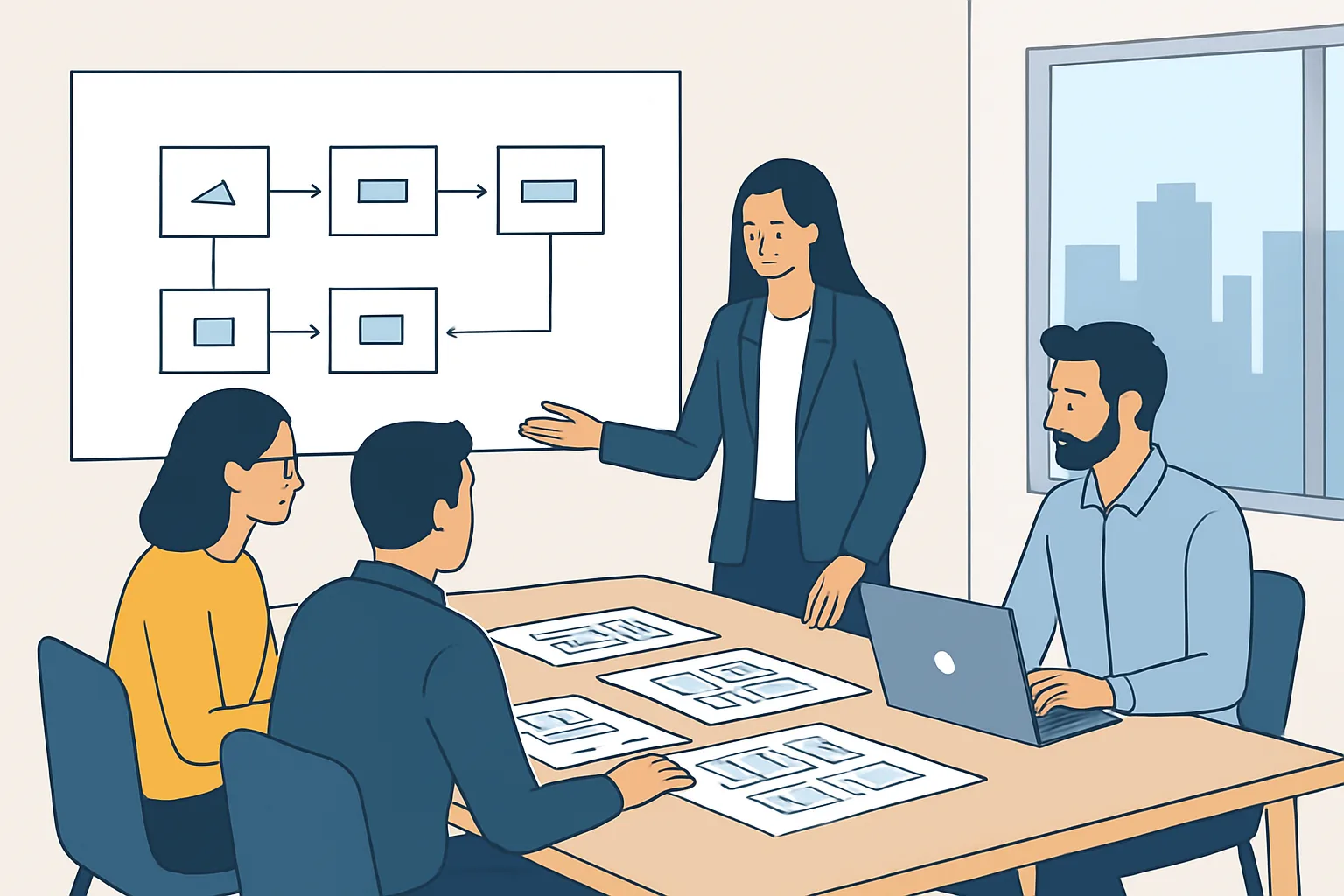
A compact but realistic process maps to Discovery → Strategy → Development → Launch. Timelines vary by complexity; expect multi-stakeholder B2B projects to take longer than single-owner small-business builds because of approvals, integrations, and content readiness.
Typical phased breakdown:
- Discovery (1–3 weeks): stakeholder interviews, analytics review, tech audit, and scope confirmation. Key output: a prioritized backlog and acceptance criteria.
- Strategy & Design (3–8 weeks): wireframes, UI design, and interaction specs. Expect 2–3 review rounds for UI with clear change limits in the contract.
- Development (4–12 weeks): front-end, CMS templating, third-party integrations (CRM, marketing automation, payment gateways), and content migration. Branching, code review, and automated test setup should be specified.
- QA & Launch (1–3 weeks): functional testing, accessibility checks, load smoke tests, and staged rollout. Include a launch checklist that covers DNS cutover, redirects, and rollback plan.
Practical constraint: integrations (ERP, custom APIs, or complex product catalogs) are the most common schedule drivers. Include a technical spike or prototype task in Discovery to validate unknown APIs and reduce risk.
Comparing execution choices: templates, custom builds, or hybrid
When evaluating proposals, compare three common approaches by effort, risk, and time-to-impact.
| Approach | Effort | Risk | Time-to-impact |
|---|---|---|---|
| Off-the-shelf template (CMS theme) | Low | Lower customization; potential brand fit issues | Fast (weeks) |
| Custom theme on a popular CMS (WordPress/Shopify/Craft) | Medium | Moderate; needs designer-developer sync | Moderate (6–12 weeks) |
| Fully custom front-end + headless CMS | High | Higher technical complexity; better long-term flexibility | Slower (12+ weeks) |
Trade-offs in practice:
- Templates cut initial cost and schedule risk but often require compromises on conversion flows and content templates; they also create technical debt if the business later needs custom integrations.
- Custom theming hits a practical middle ground: designers get layout control while developers reuse CMS features for editorial workflows and marketing integration.
- Headless or fully custom stacks offer the cleanest performance and front-end flexibility but demand stronger product and engineering discipline and a longer maintenance runway.
State who should consider each approach: a lean marketing-led product launch commonly uses a theme or custom theme; a complex product catalog or B2B portal typically needs a custom or headless approach.
Field scenarios and operational choices
Below are short operational scenarios that show how constraints change choices.
Scenario: Rapid product launch for an established retail brand
Constraint: seasonal campaign deadline and existing product photography
Choice: Use a custom theme on Shopify or WordPress with pre-built product templates. Prioritize the critical path: homepage hero, product page template, and checkout integration. Keep other pages as content blocks to be completed after launch. Include clear staging sign-off by the e-commerce manager.
Scenario: B2B SaaS site with gated demos and marketing automation
Constraint: complex lead routing, GDPR consent needs, and CRM integration (HubSpot, Salesforce)
Choice: Custom front-end with CMS templates and server-side form handling. Budget a technical spike to map webhooks and OAuth flows. Define SLA for lead delivery and a monitoring plan for form failures.
Scenario: Corporate rebrand and content consolidation for multiple regions
Constraint: many stakeholders, language variants, and regional legal copy
Choice: Headless CMS or multilingual-capable platform; produce a modular component library so regional teams can assemble pages without breaking global constraints. Allocate more time in Discovery for governance and approval flows.
Each scenario must include a named stakeholder approval step and an explicit reporting rhythm: weekly progress reports during Development and a formal UAT review with recorded acceptance criteria.
Real-world buying situations (tools, timeline, and outputs)
- Mid-size manufacturer refreshing their product site
Tools: Figma (design), WordPress with a custom theme, Gravity Forms for contact flows, GitHub Actions for CI/CD
Timeline: Discovery (2 weeks) → Design (4 weeks) → Development (6 weeks) → QA & Launch (2 weeks)
Output: responsive homepage, three product templates with schema annotations, CMS editor training pack, and a 30-day support window post-launch.
- Retail footwear brand launching a seasonal microsite
Tools: Shopify theme customization, Klaviyo for email, Cloudflare for CDN
Timeline: Discovery (1 week) → Design (2 weeks) → Development (3 weeks) → Launch (1 week)
Output: campaign landing page, product feed sync, CRO-focused PDP, and a daily post-launch monitoring checklist for inventory and checkout flows.
- SaaS firm consolidating marketing and docs
Tools: Headless CMS (Strapi), Next.js front-end, HubSpot CRM integration
Timeline: Discovery (3 weeks with API spike) → Design (5 weeks) → Development (10 weeks) → QA & Staged Rollout (3 weeks)
Output: modular documentation templates, gated demo flows with lead scoring, and API-based content sync for product updates.
How to evaluate vendors and common mistakes to avoid
Evaluation criteria that reveal delivery capability:
- Portfolio specificity: look for projects that match your complexity (e.g., Fiskars-like product displays or Caryatis e‑commerce examples). A strong portfolio shows not only visuals but annotated deliverables and post-launch outcomes.
- Process clarity: the proposal should map Discovery → Strategy → Development → Launch, include approval gates, and state the reporting cadence (weekly or biweekly). Vague proposals usually lead to scope disputes.
- Technical competence: request sample technical docs (build plan, deployment flow, and maintenance SLA). If a vendor cannot explain their branching, CI/CD, or rollback plan, treat that as a red flag.
- Support and maintenance terms: confirm response times, release windows, and hourly rates for change requests beyond the included support hours.
Common mistakes and corrective actions:
- Mistake: signing without content readiness. Corrective action: add a phased content migration scope and a content freeze date.
- Mistake: not validating third-party integrations early. Corrective action: include API spikes or sandbox tests in Discovery.
- Mistake: unclear acceptance criteria. Corrective action: require an acceptance checklist attached to each deliverable and a single person authorized to sign off.
Practical procurement tip: ask for a Project Initiation Document (PID) as a condition of contracting. A PID reduces ambiguity and becomes the operational contract for the first 60–90 days.
Pricing models and post-launch support choices
Common pricing structures:
- Fixed-price for well-scoped projects. Works when scope is locked and approvals are available, but include a change-order process.
- Time-and-materials for exploratory or iterative projects. Expect higher variability; manage by capping monthly hours.
- Retainer for ongoing maintenance and iterative improvements. Retainers are useful for regular updates, monitoring, and small CRO experiments.
Post-launch support options to negotiate:
- SLA tiers (response within 24/48 hours) and hour bundles for feature work.
- Monthly health checks: backups, dependency updates, and security patches.
- A handover and editor-training session plus editable component documentation.
For a consultative CTA, request a Free Quote or schedule a short scoping call to validate the Discovery assumptions and map a tailored delivery plan.
Frequently asked questions
What do standard web design services include?
Standard web design services typically include Discovery, UX wireframes, UI design, front-end development, CMS integration, content migration, QA, and a defined post-launch support package. For B2B projects expect additional items: stakeholder workshops, API integration work, and approval gates for legal and compliance.
How much do cost for a B2B site?
Costs vary widely by scope. Template-based builds can be lower cost but limit long-term flexibility; custom builds and integrations cost more due to engineering time. Ask potential vendors for a phased estimate (Discovery fixed fee, then scoped fixed-price or time-and-materials for Development) and include the expected number of review rounds.
Can I hire cheaper freelancers instead of full ?
Freelancers can reduce initial cost for narrowly scoped tasks (theme setup, small landing pages). However, for multi-stakeholder B2B projects that require integrations, governance, and ongoing support, a full-service provider reduces coordination friction. If choosing freelancers, ensure there is a documented handoff process and a named owner for approvals.
What is included in post-launch maintenance from ?
Post-launch maintenance commonly covers security updates, CMS and plugin updates, backups, uptime monitoring, and a number of included monthly support hours for content changes or small feature tweaks. Confirm response windows and out-of-scope hourly rates before signing.
How do I compare proposals for ?
Compare proposals on process clarity (Discovery → Strategy → Development → Launch), named deliverables, approval gates, reporting cadence, and maintenance terms. Look for concrete examples in the vendor’s portfolio that match your technical needs, and ask for references that can speak to delivery and post-launch support.